
The Cuevas del Drach, known locally as Coves del Drac, are among the most visited natural attractions in the Balearic Islands. Situated near the coastal town of Porto Cristo on the eastern shore of Mallorca, these four interconnected caves stretch approximately 4 kilometers beneath the earth's surface and descend to a depth of 25 meters below sea level.
First documented in a historical text from 1338, these caves have fascinated explorers, scientists, and visitors for centuries. The system was systematically explored by French speleologist Edouard-Alfred Martel in 1896, who mapped the extensive underground network and discovered the vast subterranean lake that now bears his name.
The Underground Lake Martel
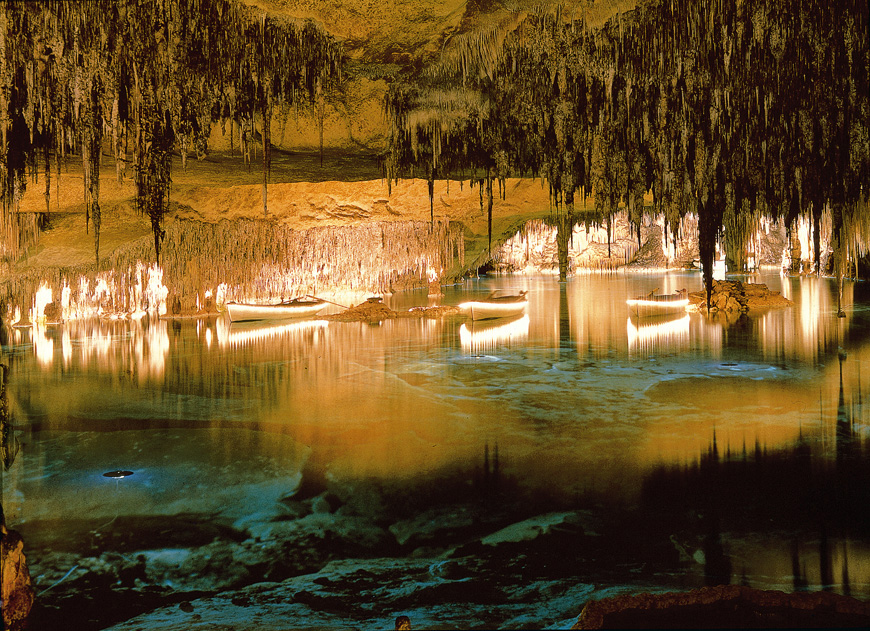
Lake Martel is the undeniable centerpiece of any visit to the Dragon Caves. Measuring approximately 115 meters in length and 30 meters in width, it ranks as one of the largest underground lakes in the world. The crystal-clear water reflects the cave ceiling with remarkable precision, creating an almost surreal mirror effect that photographers and visitors find mesmerizing.
What makes this lake particularly special is the classical music concert held during every tour. Musicians board small rowboats and perform pieces by composers such as Chopin, Bach, and Handel while drifting across the illuminated water. The natural acoustics of the cave chamber amplify and enrich the sound in ways that no concert hall can replicate. The experience typically lasts around ten minutes and is widely regarded as one of the most unique musical performances in Spain.
Visitor Information
- Location: Ctra. Cuevas s/n, 07680 Porto Cristo, Mallorca
- Opening hours: Daily, with tours running approximately every 30 minutes
- Tour duration: About 1 hour (1,200 meters walking distance)
- Ticket price: Around 16 EUR for adults, 10 EUR for children (ages 3-12)
- Temperature inside: Approximately 21 degrees Celsius year-round
- Accessibility: Partial - some areas have steps
The Four Caves
The Dragon Caves system consists of four distinct chambers, each named for its unique characteristics. The Cueva Negra (Black Cave) and the Cueva Blanca (White Cave) were the first sections known to locals. The Cueva de Luis Salvador, named after Archduke Ludwig Salvator of Austria who explored the caves in the 19th century, connects to the deeper Cueva de los Franceses, which was mapped during the French expedition led by Martel.
Walking through these chambers, visitors encounter an extraordinary variety of geological formations. Enormous stalactites hang from the ceiling like frozen waterfalls, some reaching lengths of several meters. Stalagmites rise from the cave floor in columns and towers of varying colors, from pure white calcite to warm amber and ochre tones created by mineral deposits over millennia.
Geological Formation
The Cuevas del Drach formed within Miocene-era limestone, with the primary carving process driven by the dissolution of rock by slightly acidic rainwater seeping through the ground over millions of years. The stalactites and stalagmites visible today grow at an incredibly slow rate, typically adding just a few centimeters per century.
The cave system sits at a geological crossroads where freshwater from underground rivers meets saltwater from the nearby Mediterranean Sea. This interaction creates distinctive mineral patterns and contributes to the unique turquoise hue of Lake Martel's water.
How to Get There
Porto Cristo is easily accessible from Palma de Mallorca, the island's capital, by car or public bus. The drive takes approximately one hour along the Ma-15 motorway. Regular bus services operated by TIB (Transport de les Illes Balears) run from Palma's main bus station, with the journey taking about 75 minutes.
From the popular resort areas of Cala Millor and Cala d'Or, the caves are within a 20 to 30 minute drive. Many tour operators across Mallorca offer excursion packages that include transport, entrance tickets, and occasionally a boat ride at the nearby port.
Best Time to Visit
While the caves are open year-round and maintain a constant interior temperature, the visitor experience varies significantly by season. Summer months (June through August) see the largest crowds, with waiting times of up to an hour for entry even with pre-booked tickets. For a more relaxed visit, consider traveling during spring (April-May) or autumn (September-October), when the weather in Mallorca is still pleasant and the caves are considerably less busy.
Winter visits offer the quietest experience, with minimal queuing and a more contemplative atmosphere. However, some tour operators may reduce the frequency of English-language tours during the low season, so checking the schedule in advance is advisable.
Nearby Attractions
After exploring the underground world, Porto Cristo offers several above-ground attractions worth visiting. The town's natural harbor and beachfront promenade provide a pleasant setting for a seafood lunch. The Cuevas dels Hams, another smaller but equally charming cave system, is located just a few kilometers away and can be visited on the same day.
For nature enthusiasts, the Mondrag Natural Park lies about 20 minutes south by car and offers hiking trails through pine forests leading to secluded beaches with pristine turquoise waters. The combination of underground exploration and coastal nature makes Porto Cristo and its surroundings a well-rounded day trip from anywhere in Mallorca.
For more information about visiting, check the official Cuevas del Drach website or the Spain Tourism portal.